Showing posts with label frame study. Show all posts

Friday, 9 October 2020

Rivers and Tides: Andy Goldsworthy Working with Time - Frame Study from Documentary

Hello Readers !

Nature, an independent entity which operates autonomously, taking all pride to change by itself and growing from nothing to large landscapes, trees, streams, oceans. forests, mountains and so on. It can also be seen as an art.

Art, if its prepared in a controlled environment it lasts longer. Many art installation are put in museums and at art centers. Under the shelter of around the walls, art can only increase the ego of an artist or monetary valuation, but what if one allows nature to interfere in one's created art ? What if the art sustains for long in open nature ? And what if it does not ?

Rivers and Tides is a documentary film focuses on the nature of nature, its responsiveness to human beings. Andy Goldsworthy, an environmental artist who works with time. He makes several art sculptures taking raw material from nature itself and observes that how nature deals with that art, and also that how long it goes to sustain in an open nature. In this blog a frame study has been done to explore the themes and symbols of nature and its reaction to the art sculptures made by Andy Goldsworthy.

Rivers and Tides: Andy Goldsworthy Working with Time

Director: Thomas Riedelsheimer
Screenplay: Thomas Riedelsheimer
Released: 7 March 2002 (Germany)


* River - a symbol of movement and progress. It also signifies time, because just like time, river never stops flowing. It's flow is also a symbol of successive continuity.
* Tide - a symbol of carrying away with something. It also symbolizes destruction.


"Art for me is a form of nourishment. I need land."


A design created on the surface of a frozen water.


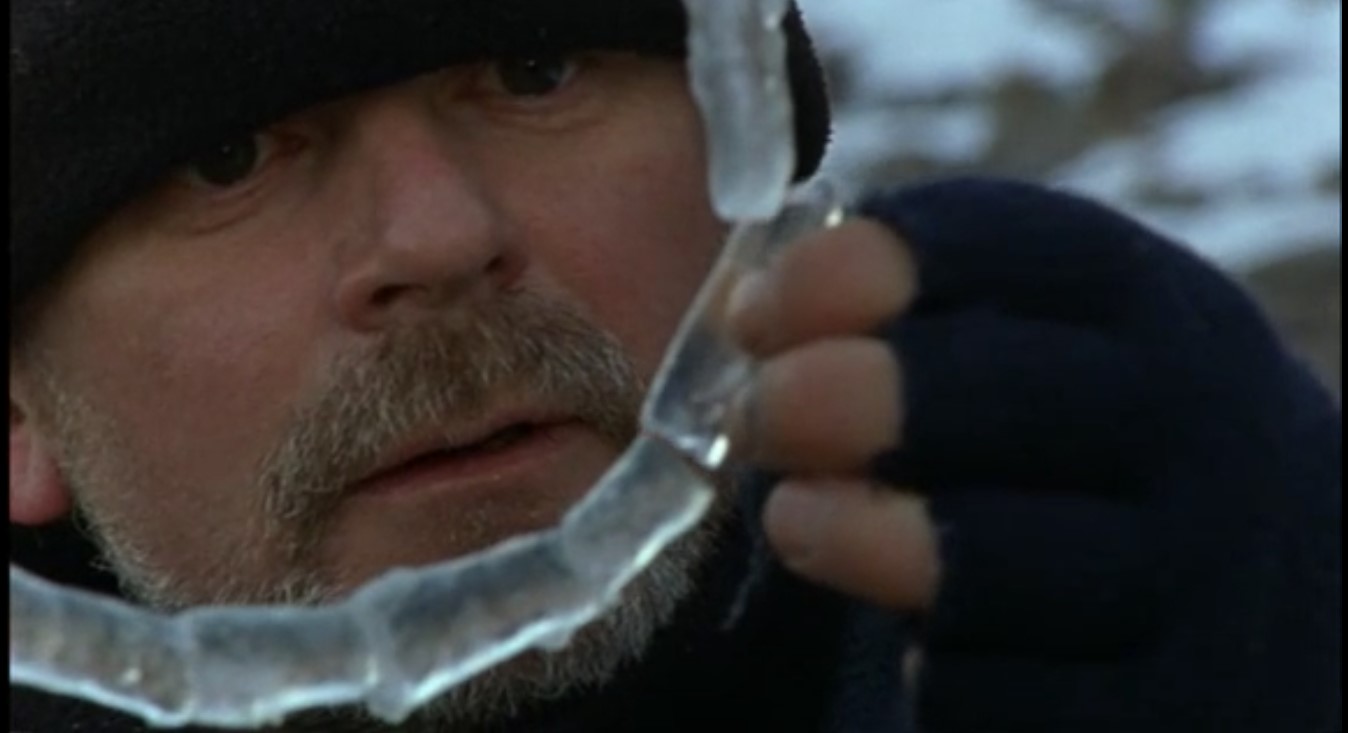
This shape is made up of ice pieces. It is quickly melted within few hours or minutes.


This is the result of the hard work done by humans and . . .


The art is vanished by the sunrays.


For this art, Goldsworthy chooses a place where river merges with ocean. Before tide comes, Goldsworthy prepares a round shaped wooden structure which looks like a roof of a religious building, and as if a hole is kept intentionally open for ventilation. For this art, he uses soaked tree branches and sticks.


But when the water surface increases by tide, the structure starts floating and is carried away. Goldsworthy here says, it doesn't seem like destruction but it looks like it is being taken to another place.


"On the moment when something collapses, its intensely disappointing." He reflects on the collapse of the stones. "This is the fourth time it's fallen and each time I got know stone little bit more, I got higher each time, so it grew in proportion to my understanding of the stone and that's really what one of the things my artists trying to do. He is trying to understand the stone. I obviously don't understand it well enough, yet."

He wants to make stone art in the shape of eggs. He tries to make it at different locations, one in the forests, a plain land nearby and one at the seashore. Then he observes the trajectory of both the places. One is covered with green plants and other one is surrounded by water by the time of tide.


If any art is kept under the guardianship or under vigilance, then it has no importance.

Stone art at the roadside. 


Ice structure.


This frame has cleverly captured the natural design of stones. It is also a similar to the design Andy Goldsworthy often draws in the documentary. This ups and downs and highs and the lows are also engraved in in human nature also. This frame has captured that rendition.


Goldsworthy prepares such art in various locations in nature and observes the natural process, whether it is destroyed quickly or not.


Each stone is kept very carefully because it's setup is necessary while creating any art.


Here, even after the tide is gone, Goldsworthy's art sustains. 


A small area that is nurturing youth and blossoming with the blend of nature. Just like nature, these player also cultivating sportsman spirit. A temperament of moving on in life.

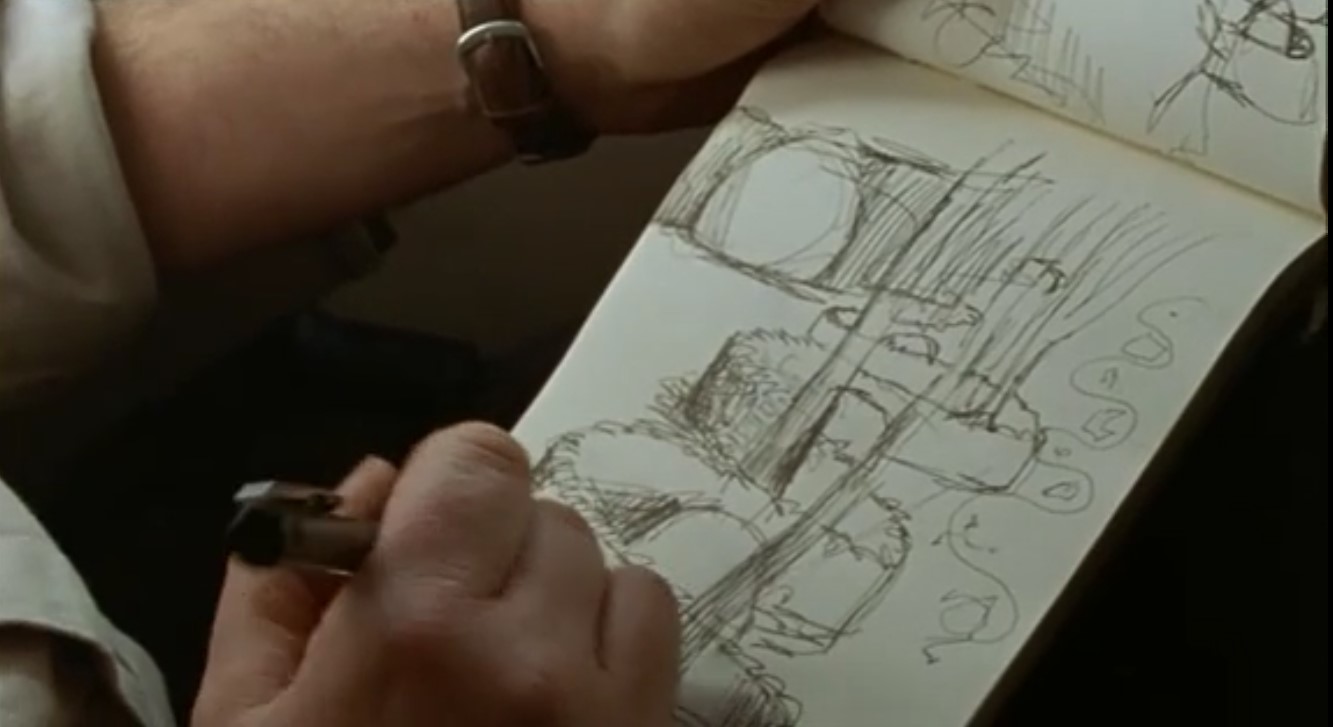

He also captures raw sketches in his diary.


This frame is captured from helicopter and it seems that this design has inspired Andy Goldsworthy to create the similar ones in different parts of nature.


This is the only frame where we find a contrast to the art he is creating in nature and the archived pieces of arts are preserved at his house. Also a blend of technology as we can see a desktop at the table. In short, art which he creates in nature is vanished very soon, within few seconds and minutes but here in his house he has preserved all the arts he has made.


Here, Andy Goldsworthy is trying to stop his art being vanished by his hand but nature has to be itself. He has created this 'web' with small wooden sticks and joined them through thorns.


His frustration is reflected in this frame. This is how humans are tend to preserve somethings and if it doesn't happen we all get frustrated and anxious. But it doesn't matter how much we are frustrated but how quickly we become free from that and overcome our anxiety is important.


This is the woolen art. Strings are spread all across the stone edges and its shining in the sunlight. It is also evident that wool is also something what we directly get from nature. Sheep is the animal who is quite rigid in nature and always follows the herd. But the wool we get from it, is quite opposite in nature. Wool is a symbol of tenderness and softness, which signifies positivity and kindness. But sheep is narrated very differently in various fields such as politics.


Even if someone travels in nature and wants to create something. No other instruments or other objects are required. Human body itself words as an instrument while working with nature.


Here are the seasonal changes recorded in the design made up from wooden sticks.


This frame is a kind of paradoxical in nature. Andy Goldsworthy here puts yellow flowers in a steady spot of water just nearby the fast flowing stream.


This wall of stones is a kind of dialogue to the trees.

This documentary is beyond the words. It takes us to a spiritual journey and transforms all our understanding of nature. One can surely say a true artist is always ready to witness the art's decay. It is possible only if one is spiritually mature.

Thank You!

To the Lighthouse - Film Adaptation of the Novel

Hello Readers!

To the Lighthouse, a novel by Virginia Woolf, has enormously innate and insightful stream of consciousness. It is evidently found, many a times, in the forms of literary texts and its film adaptations that texts explain better than the frames. In light of the current audience of 21st century, majority would go to films, than to read texts. But, artistic liberty or creative liberty takes place in films, sometimes for attracting the larger audience or sometimes to do experiments with frames. This blog also covers a film adaptation of much celebrated novel To the Lighthouse.

In order to understand the film frames, one may need to be familiar with the original text also. For better understanding here are some links to have quick view.


Film: To the Lighthouse
Director: Colin Gregg
Released: 1983


Frames from the film


The first two opening frames begin with a fade in... Camera focuses on the objects like doll and toys. Which is the center of children's attraction. Frame is also indicating the upcoming narration which is going to be child-centric. 


The third frame, that directly introduces us to a sleeping girl, affirms the viewers' former prediction about the story of film.


This is the fourth frame which is an entry of James, a character whose wish is to visit the lighthouse. The night scene captures the longingness and waiting for something. When a character is awake in the late night, it is assumed that he/she is thinking something significant, or worrying something, planning something, wishing something. Here James looks at the lighthouse through the window. His wish is going to be a driving force for the film.

There are some novels also written specially for the film adaptation which carries the screenplay and narration both. But here in this film, director has taken the liberty to put this core idea of the novel at the very initial frames to give better viewing experience to the audience.


The white dot in the fifth frame is actually the far stated lighthouse at which James is looking. The narration of camera and narration of books are quite different. We see the lighthouse through the eyes of James.


Those who have read the novel may quickly get the idea about the summer house. This big house having a design of around early 20th century, conveys the wealth and prosperity of the people included in the story.


Mr. Ramsay who is interested in philosophical talks at dining table. He is talking about a metaphysical essay "Appearance and Reality" by F H Bradley.


James biting his thumb nails, is a sign of frustration and anger towards his father. In the novel we find a long description of James' hate towards his father that even he could find and axe or any weapon, he would have directly stabbed it to his father's chest. And here this expression is framed with grinning face of James.


A girl is looking at James and Mrs. Ramsay from the bushes. The gaze of child in this way is always with the motive of comparison. Parents can't be biased with the love and acceptance they give to their children. But here Mrs. Ramsay seems to be more close to James.


For a wealthy family, playing cricket was the favorite pastime activity. Here Ramsay family plays cricket while they are on the vacation stay at the summer house.


Lily Briscoe is a character who finds her own voice through her painting. She paints a landscape and then tries to paint Mrs. Ramsay also. She is thinking about life. Her dialogues are: "Sea, teams with eternal life, yet threatens with oblivion."


Lily further thinks about James, that he is like a kite and the string is in the hands of Mrs. Ramsay. This frame also captures the textual reference of this line. James is coming down to the hill like a kite.


Charles Tansley wants his scholarly dissertation to be checked by Mr. Ramsay and he finds some opportunity to talk about this. But Mr. Ramsay seems a bit loose in checking the chapters.


1:08:11
Lily Briscoe paints Mrs. Ramsay. As the novel says, Mrs. Ramsay wants herself to be remembered for long time. In addition, Lily also wants to pursue her painting. As it was a quite rebellious act in the early 20th century. It was a time of end of Victorian era. Still the Victorian thoughts were quite prevalent.


1:12:55
In this frame, James is upset by the striking order of his father. Mr. Ramsay harshly said, "There will be no trip to the lighthouse tomorrow." Mrs. Ramsay consoles James.


1:34:50
Mr. Ramsay at a dinner table. When Augustus Carmichael talks about a poem he had written at 17 years and tries to remember the magazine in which the poem was published. Here, Mr. Ramsay speaks a significant dialogue. That, "What we produce in the flush of our youth, is often the best we ever produce, then we sing our melody. From then on its elaborate harmonies and orchestration, but the melody is already sung."


1:48:18
The boat is now sailed off to the lighthouse. James wish is now fulfilled.


1:51:30
Lily completes her painting of Mr. Ramsay. She pursued her passion and fulfilled it.

In the blog of Dilip Barad sir, some questions were also asked with reference to this novel.

1) Reference to Shakespeare

Mrs. Ramsay reads Shakespeare's sonnets.

2) Reference to India

There is also a passing reference of India in the novel. Here are the quotes from the original text where India is mentioned.

(1) "...for reasons she could not explain, for their chivalry and valour, for the fact that they negotiated treaties, ruled India, controlled finance; finally for an attitude towards herself which no woman could fail to feel or to find agreeable... to the marrow of her bones!"

This was the reference found in the first part The Window. Mrs. Ramsay's approach towards the hospitality and his affection with men's care taking. The reasons are vaguely discussed why Mrs. Ramsay is much leaned on the nature of hospitality.

(2) "... Bank of England, and the Indian Empire, of ringed fingers and lace, though to them all there was something in this of the essence of beauty, which called out the manliness in their girlish hearts, and made them, ...  been invited to stay with them—in the Isle of Skye."

India is described, in this paragraph, as prosperous and a good place to live. India has empathy and love with romance and adventure.

"(3) Holding her black parasol very erect, and moving with an indescribable air of expectation, as if she were going to meet some one round the corner, she told the story; an affair at Oxford with some girl; an early marriage; poverty; going to India; translating a little poetry “very beautifully, I believe,” being willing to teach the boys Persian or Hindustanee, but what really was the use of that?—and then lying, as they saw him, on the lawn."

This excerpt is from the first part. August Carmichael thinks about India and its a kind of achievement to him to visit India.

(4) "But which was it to be? They had all the trays of her jewel-case open. The gold necklace, which was Italian, or the opal necklace, which Uncle James had brought her from India; or should she wear her amethysts?"

This is a reference where Rose wants to choose which necklace to wear. Mrs. Ramsay also helps her out. A necklace from India is a sign of some worthy possession of a valuable things which is famous even outside India.

(5) "The autumn trees, ravaged as they are, take on the flash of tattered flags kindling in the gloom of cool cathedral caves where gold letters on marble pages describe death in battle and how bones bleach and burn far away in Indian sands."

Here, India is taken as an unknown yet good place to visit.

(6) "Her horizon seemed to her limitless. There were all the places she had not seen; the Indian plains; she felt herself pushing aside the thick leather curtain of a church in Rome."

Again here, India is described as a breathtaking land. A desirable place to travel.

3) Reference to Philosophy

* Philosophical points are discussed by Mr. Ramsay. He, at the dinner table, talks about F. H. Bradley's essay, Appearance and Reality.
* One more reference of philosophy is, when Mrs. Ramsay thinks about her husband Mr. Ramsay and his work. She thinks about a philosophical trajectory, that a persons thinking can be patterned from A to Z. But in Mr. Ramsay's case, he is unable to move beyond Q. He is stuck somewhere at Q. In short, Mrs. Ramsay thinks that her husband isn't making a mark in his philosophical field. She is also afraid that someone would become more successful than Mr. Ramsay, as if this was any race of thinking.

We get some quotes from original text about this as following.

"It was a splendid mind. For if thought is like the keyboard of a piano, divided into so many notes, or like the alphabet is ranged in twenty-six letters all in order, then his splendid mind had one by one, firmly and accurately, until it had reached, say, the letter Q. He reached Q. Very few people in the whole of England ever reach Q."

"He had not genius; he laid no claim to that: but he had, or might have had, the power to repeat every letter of the alphabet from A to Z accurately in order. Meanwhile, he stuck at Q. On, then, on to R."

References

Barad, Dilip. India in Virginia Woolf's Lighthouseblog.dilipbarad.com/2015/09/india-in-virginia-woolfs-lighthouse.html

Barad, Dilip. Worksheet: Virginia Woolf's To The Lighthouse. blog.dilipbarad.com/2014/09/worksheet-virginia-woolfs-to-lighthouse.html

Thank You!