Showing posts with label film. Show all posts

Saturday, 13 December 2025

Maa Ka Doodh (माँ का दूध) Full Movie | Hindi | 4K


https://www.youtube.com/watch?v=XhTOLeevtQw

You'll love to visit this website: https://maakadoodh.in/break-the-chain/


https://youtu.be/EiukdpBo9sY?si=KGJsflPDrW_0lyg1


I know, truth is bitter and hits harder than we think, but it's always and forever good for health.

Reflect, review, reassess your choices, actions, and...

Thank me later!

Tuesday, 10 September 2024

Kitaab (1977): One Film, Numerous Feelings

Directed by Gulzar, Kitaab is a thoughtful exploration of childhood innocence, perception, and the complexities of adult life as seen through the eyes of a child. The film is notable for its nostalgic yet realistic portrayal of how children view the world, blurring the line between fantasy and reality.

A YouTube link for the film


Plot Summary:

Kitaab follows Babla (Master Raju Shrestha), a young boy who is sent away from home to live with his elder sister and attend school in the city. The film begins on a light note, showcasing Babla's playful and carefree nature. However, as he adjusts to life in the city, he becomes disillusioned by the adult world and its hypocrisies. He faces academic pressures, misunderstandings with his family, and the rigidity of societal norms, which eventually lead to his inner turmoil.

The title Kitaab (meaning "book") symbolizes Babla's journey of learning—both the lessons taught in school and the harsh realities of life.

Themes:

Gulzar crafts a narrative that critiques the education system and the loss of innocence as one grows older. The film shows how Babla struggles to reconcile his imaginative and free-spirited worldview with the often harsh and unforgiving adult world. The story emphasizes how children, despite their naivety, have a keen understanding of their surroundings, even if their interpretations are different from those of adults.

Noteworthy Scenes:

  1. Babla's Escape into Imagination: In several sequences, Babla daydreams to escape the strictness of school life and the burdens of being "grown up." In one particularly memorable scene, he imagines the letters in his textbook coming to life, dancing around him. This whimsical portrayal of a child's mind captures the film's essence—his internal conflict between the freedom of imagination and the confines of reality.

  2. The Train Ride: A significant part of the film focuses on Babla's train journey from his home to the city. This journey is symbolic of his transition from childhood innocence to a more complicated world. The train ride also represents Babla’s internal journey, where he experiences moments of realization and confusion. The cinematography of the landscape passing by highlights his distance from the world he once knew.

  3. Babla's Confrontation with His Teacher: In a scene that reflects the flaws of the education system, Babla is reprimanded by his teacher for his poor handwriting and inability to conform to the structured demands of school life. This moment stands out as Babla’s first experience of how society’s institutions suppress creativity and enforce conformity. His frustration is palpable, and it echoes the emotional struggles many children face in academic settings.

  4. Climactic Breakdown: Toward the film's end, Babla has a breakdown after a series of misunderstandings with his sister and brother-in-law. In one emotionally charged scene, he runs away, expressing his frustration at how he feels ignored and misunderstood by the adults around him. The combination of his innocent grievances and the overwhelming pressure he faces from the world creates a powerful moment of empathy for his character.

  5. Final Sequence: In the closing moments of the film, Babla returns home, only to find that the "freedom" he longed for also has its limitations. He learns that adults are not as free as they seem—they, too, are bound by societal rules and expectations. The ending is bittersweet, leaving viewers with a sense of nostalgia for their own lost childhoods and a contemplation of how the adult world often stifles creativity and innocence.

Performances:

Master Raju Shrestha delivers a natural, engaging performance as Babla, bringing both charm and depth to the character. His portrayal of a child trying to understand the complexities of adult life is heartwarming and relatable. Vidya Sinha and Uttam Kumar, who play Babla's sister and brother-in-law, provide nuanced performances, representing the well-meaning yet flawed adult figures in his life.

Cinematography and Music:

The film’s cinematography by K. Vaikunth beautifully captures both the vibrant world of Babla's imagination and the more mundane reality of the adult world. R.D. Burman’s music complements the film’s narrative, particularly the song "Dhanno Ki Aankhon Mein," reflecting Babla’s childlike wonder and joy. The melodies enhance the film's emotional depth, elevating its poignant moments.

Conclusion:

Kitaab is a thoughtful, layered film that explores the delicate transition from childhood to adulthood. Gulzar masterfully presents the inner workings of a child's mind, portraying the beauty and struggles of navigating a world that often overlooks the innocence and intelligence of children. It’s a timeless film that resonates with anyone who has ever felt the pangs of growing up.

N.B. This blog is written with the assistance of ChatGPT 4o.

Friday, 18 June 2021

Shiva Baby | Film and Culture | Openness of Thought

Welcome Readers!

It was a YouTube advertisement of an online film screening platform and a film trailer was shown. It seemed as casual as other film trailers hit the screen but what made me curious about it was the title.

Click Here to watch the trailer.

Yes. Shiva Baby. Indeed an eye-sparkling title for Indian audience. Digging deeper got me to the real fact about the real context of the word shiva. The film has no connection with Hindu god Shiva but it has a completely different perspective. Well, this makes me question that are we open to multiple cultures? How much do we know about other religions and their rituals and myths around them? These are not the questions of national interest or whose-who-GK kind but they too have their places.

Cultural Openness

The world has become a global village and in the time of fast progression and development, one needs to be open and sporty about all the cultures and religions around the world.

Meaning and the Context

Shiva is a Hindu god and the supreme strength in all respects among the Trimurti - Brahma Vishnu and Mahesh. But shiva is also a name of ritual of lamentation, mourning in Judaism. Isn't it beautiful that how two cultures share similarities and yet they are celebrated in different contexts? If one looks with wider view point, many stories of gods are much similar.

Here's a paragraph on this ritual. According to Wikipedia entry,

Shiva (Hebrew: שִׁבְעָה‎, literally "seven") is the week-long mourning period in Judaism for first-degree relatives. The ritual is referred to as "sitting shiva" in English. The shiva period lasts for seven days following the burial. Following the initial period of despair and lamentation immediately after the death, shiva embraces a time when individuals discuss their loss and accept the comfort of others.[1]

Its observance is a requirement for the parents, siblings, spouses, and children of the person who has died. It is not a requirement for an individual who was less than thirty days old at the time of death.[2] At the funeral, mourners wear an outer garment that is torn before the procession in a ritual known as keriah. In some traditions, mourners wear a black ribbon that is cut in place of an everyday garment.[3][4] The torn article is worn throughout the entirety of shiva. Typically, the seven days begin immediately after the deceased has been buried. Following burial, mourners[5] assume the halakhic status of avel (Hebrew: אבל, "mourner"). It is necessary for the burial spot to be entirely covered with earth in order for shiva to commence. This state lasts for the entire duration of shiva.

During the period of shiva, mourners remain at home. Friends and family visit those in mourning in order to give their condolences and provide comfort. The process, dating back to biblical times, formalizes the natural way an individual confronts and overcomes grief. Shiva allows for the individual to express their sorrow, discuss the loss of a loved one, and slowly re-enter society.[6]

A detailed, well-documented guide of how this ritual is conducted and followed in Judaist culture.

Now we have two contextual meanings of Shiva. Let's be open, and think global.

Happy Perspectives !!!

Friday, 27 November 2020

Harold Pinter's Birthday Party - Thinking Activity - Worksheet

Hello Readers!

Here is the worksheet of the film screening of 1968 film The Birthday Party directed by William Friedkin.

Date: 1968
Director: William Friedkin
Actors: Robert Shaw, Patrick Magee


Click here to visit teacher's blog on the worksheet questions of this film.

* Post-Viewing Tasks:

1. Why are two scenes of Lulu omitted from the movie?

Ans: It can be said that perhaps the director wanted to have the audience etiquettes related with the film and in terms of artistic liberty, the director might not be willing to compromise with the target audience. Although when the film released, the time of 1950s and 60s, society might be having Victorian notions. As such it was necessary to remove or omit the two scenes from the film.

2. Is movie successful in giving us the effect of menace? Where you able to feel it while reading the text?

Ans: While reading Harold Pinter's play, I was unable to identify the feeling of menace. Whereas in the film I was able to feel the menace effect because of the sound of knocking the doors and tearing the newspaper.

3. Do you feel the effect of lurking danger while viewing the movie? Were you able to feel the same while reading the text ?

Ans: Yes the lurking danger of unknown was felt in both, while reading and while watching the film. At first, Goldberg and McCann seemed very decent and well to do people, but as the play unfolds to eyes, their hidden intentions started coming to the surface.

4. What do you read in 'newspaper' in the movie? Petey is reading newspaper to Meg, it torn into pieces by McCain, pieces are hidden by Petey in last scene.

Ans: Newspaper is used as a symbol of power. Because the one who reads newspaper holds some power position in the play. For example Petey is reading newspaper and his wife Meg is asking about the trivial things. Now Petey may give answer with facts or with wring info, in such way Petey holds the power position. But when we look at the another scene of Petey hiding the torn pieces of newspaper, we suspect that he might be knowing who Goldberg and McCann actually are.

5. Camera is positioned over the head of McCain when he is playing Blind Man's Buff and is positioned at the top with a view of room like a cage (trap) when Stanley is playing it. What interpretations can you give to these positioning of camera?

Ans:

6. "Pinter restored theater to its basic elements: an enclosed space and unpredictable dialogue, where people are at the mercy of one another and pretense crumbles." (Pinter, Art, Truth & Politics: Excerpts from the 2005 Nobel Lecture). Does this happen in the movie?

Ans: When Petey and Meg allowed the duo of Goldberg and McCann to stay in boarding house, it seemed that these two are having something good around them. But by their behaviour we come to know that they are about to do suspicious activity in the house. Their inhuman way of interrogating Stanley describes their hidden instincts.

7. How does viewing movie help in better understanding of the play ‘The Birthday Party’ with its typical characteristics (like painteresque, pause, silence, menace, lurking danger)?

Ans:

8. With which of the following observations you agree:
- “It probably wasn't possible to make a satisfactory film of "The Birthday Party."
- “It's impossible to imagine a better film of Pinter's play than this sensitive, disturbing version directed by William Friedkin”

Ans:

9. If you were director or screenplay writer, what sort of difference would you make in the making of movie?

Ans: If I would be the director of this film, I would have added few more scenes of Nat Goldberg and McCann blackmailing or threatening Petey and Meg. Because one interpretation can also be given about their silence and all-right kind of behavior that perhaps they might have been threatened by Goldberg and McCann. Perhaps they are not supposed to raise their voice against the activity Goldberg and McCann are about to conduct. Their anxiety and agony should be screened in this film. I would have included this part in the film.

10. Who would be your choice of actors to play the role of characters?

Ans: Stanley.

11. Do you see any similarities among Kafka's Joseph K. (in 'The Trial'), Orwell's Winston Smith (in 'Nineteen Eighty-Four') and Pinter's Victor (in 'One for the Road')?

Ans :

Tuesday, 24 November 2020

Waiting for Godot - Thinking Activity

Hello Readers!

With reference of an online film screening conduced online on 24th Nov 2020, this blog contains the  worksheet and follow up of the play "Waiting for Godot" discussed in the class. Samuel Beckett was a modern playwright and was associated with the "Theatre of the Absurd". This play is originally written in French with the title En Attendant Godot. 

Source Worksheet blog of questions - Click Here

* What connection do you see in the setting (“A country road. A tree. Evening.”) of the play and these paintings?


Ans: These are the paintings by Casper David Friedrich, titled as "Longing." Samuel Beckett has taken the inspiration for the setting of the play "Waiting for Godot". Two persons in the paintings connects us with two main character of the play Vladimir and Estragon. The barrenness of the tree also suggests absurdity of life, emptiness and nothingness. As the two persons in the painting are waiting for something, Vladimir and Estragon are also waiting for Godot.

* The tree is the only important ‘thing’ in the setting. What is the importance of tree in both acts? Why does Beckett grow a few leaves in Act II on the barren tree - The tree has four or five leaves - ?


Ans: Optimistically looking at the leaves, one can say that leaves are symbol of growth, newness and hope. As such there is no hope, no newness and no tone of growth in the play, still tree as part of nature works in its own way. As natural elements like water, greenery, air, fire. . . have nothing to do with human pain, agony, anxiety, frustration and restlessness. Nature is uncaring and indifferent to human being.

* In both Acts, evening falls into night and moon rises. How would you like to interpret this ‘coming of night and moon’ when actually they are waiting for Godot?


Ans: The fall of night and rise of the moon in the play can be read as if the moon is observing the miserable humans from the heavens. In the play an interesting dialogue comes,

Vladimir: Will night never come ?
Estragon: (Contemplates Moon) "Pale Wariness... of climbing heaven and gazing on the like of us."

The absurdity and paleness is felt from this dialogue.

* The director feels the setting with some debris. Can you read any meaning in the contours of debris in the setting of the play?

Ans : Debris is a useless biproduct of building materials. While demolishing the buildings and houses, lot of debris is found. The director has used the debris very cleverly as the setting of the play is countryside road. In order to increase coarseness and barrenness in the play, debris is used.

* The play begins with the dialogue “Nothing to be done”. How does the theme of ‘nothingness’ recurs in the play?

Ans :

* Do you agree: “The play (Waiting for Godot), we agreed, was a positive play, not negative, not pessimistic. As I saw it, with my blood and skin and eyes, the philosophy is: 'No matter what— atom bombs, hydrogen bombs, anything—life goes on. You can kill yourself, but you can't kill life." (E.G. Marshal who played Vladimir in original Broadway production 1950s)?

Ans :

* How are the props like hat and boots used in the play? What is the symbolical significance of these props?

Ans : Hat signifies mind. Boots signify body. Estragon wears boots and he is not able to remove the boots at first, just like desires and body urges. Just like boots get vanished and get rusty, Estragon also forgets many things as if his memory is also like his boots. Vladimir wears hat and he thinks a lot. He remembers many things.

* Do you think that the obedience of Lucky is extremely irritating and nauseatic? Even when the master Pozzo is blind, he obediently hands the whip in his hand. Do you think that such a capacity of slavishness is unbelievable?


Ans:

* Who according to you is Godot? God? An object of desire? Death? Goal? Success? Or . . .

Ans : Godot is an object of desire. Desire is an endless vicious chain that ultimately leads us nowhere. If we observe a toddler playing with toys, we come to know that as soon as it looks at the better toy than it carries, it will leave that toy and will crave, run and cry for the better toy. This desire perhaps comes from the binary comparison that is hardwired in our mind. For grown ups, this desire is perhaps money, material wealth, luxuries, physical fulfilment, emotional acceptance, public recognition and fame, and what not. . . Goals and success are also sprouted from desire. Passion is also nothing but desire. Desire can be compared as fire also, which never gets extinguished.

* “The subject of the play is not Godot but ‘Waiting’” (Esslin, A Search for the Self). Do you agree? How can you justify your answer?

Ans :

* Do you think that plays like this can better be ‘read’ than ‘viewed’ as it requires a lot of thinking on the part of readers, while viewing, the torrent of dialogues does not give ample time and space to ‘think’? Or is it that the audio-visuals help in better understanding of the play?

Ans : For many, reading a play is more preferable than to watch it. But, plays are actually performed in the mind of the playwright. Then it gets penned on the paper. So basically its a matter of performance. Theatrical performance makes the written play more lively and meaningful. So far as Waiting for Godot is concerned, it should be read first and then to be watched also. Because, even after reading the simple and straight forward language of this play, one requires visual clarification for what one has read. Then, the torrent of dialogues and rapidness of speech becomes more clear while watching.

Yes, the audio-visual helps in better understanding of the play.

* Which of the following sequence you liked the most:
- Vladimir – Estragon killing time in questions and conversations while waiting


- Pozzo – Lucky episode in both acts
- Conversation of Vladimir with the boy

Ans:

* Did you feel the effect of existential crisis or meaninglessness of human existence in the irrational and indifference Universe during screening of the movie? Where and when exactly that feeling was felt, if ever it was?

Ans:

* Vladimir and Estragon talks about ‘hanging’ themselves and commit suicide, but they do not do so. How do you read this idea of suicide in Existentialism?

Ans: Suicide is a very bold statement against all the whys of living life. Albert Camus mentions about philosophical suicide in which if one denies to think or question anything one is doing a philosophical suicide. In this play, Vladimir and Estragon can be read as profound existentialists. They are ready to try everything to meet Godot. But at the same time they feel insecure whether they might fail to kill themselves.

* Can we do any political reading of the play if we see European nations represented by the 'names' of the characters (Vladimir - Russia; Estragon - France; Pozzo - Italy and Lucky - England)? What interpretation can be inferred from the play written just after World War II? Which country stands for 'Godot'?

Ans: Germany stands for Godot. As the character of Godot is absent and silent but to consider Godot as God then, Germany best fits in terms of World War II. Adolf Hitler was a German dictator and he occupied many countries including many European countries like Russia France, Italy, England.
(Click Here to view the map. Click Here to know more about World War II). In this way one can politically connect all the characters and countries which are waiting for Germany to liberate them.

* So far as Pozzo and Lucky [master and slave] are concerned, we have to remember that Beckett was a disciple of Joyce and that Joyce hated England. Beckett meant Pozzo to be England, and Lucky to be Ireland." (Bert Lahr who played Estragon in Broadway production). Does this reading make any sense? Why? How? What?

Ans:

* The more the things change, the more it remains similar. There seems to have no change in Act I and Act II of the play. Even the conversation between Vladimir and the Boy sounds almost similar. But there is one major change. In Act I, in reply to Boy's question, Vladimir says:

"BOY: What am I to tell Mr. Godot, Sir?
VLADIMIR: Tell him . . . (he hesitates) . . . tell him you saw us. (Pause.) You did see us, didn't you?

How does this conversation go in Act II? Is there any change in seeming similar situation and conversation? If so, what is it? What does it signify?

Ans: The lines are changing with the word from 'us' to 'me'. In the Act II, Vladimir changes the tone of the thought and speaks: 'tell him you saw me'. In the Act II, This conversation happens between Vladimir and Boy, where Estragon is sleeping. If Estragon represents the body and Vladimir mind, then perhaps one can state that, mind is the ultimate master of the body and mind knows that the body is material thing and going to decay with time, but perhaps it is the consciousness that goes somewhere. This way one can see the selfishness in Vladimir's character. Even after being together throughout the play, Vladimir changes his mind and willingly forgets Estragon. A Gujarati quote that comes to mind,
"અંતે તો સગા સૌ સ્વાર્થનાં"

Vladimir's selfishness also seems forgivable because on a larger way if one thinks, all the humans are tied with one another with some kind of need and requirements. If its all about give and take, then such selfishness is also legible, and forgivable as per the human temperaments. Even after the death of any near and dear ones, people forget them and move on with life. So, this is also a considering aspect of human predicament.

Sometimes life gives many crucial choices to make. And humans mostly go for the personal benefits. For better prospects of life, children go for foreign countries and they forger their parents. Even after death of their parents they don't come to native place.

These are the slightly awkward sides of human life and various situations but if one thinks about a larger and most adverse situations, one comes to know that nothingness prevails everywhere. Still its life, that goes on. . .

Thank You!

additional reading:

Monday, 16 November 2020

Film Review: Postcolonial Films: Midnight's Children, The Reluctant Fundamentalist, The Black Prince and Victoria & Abdul

Hello Readers !

This blog is part of postcolonial studies and it contains film reviews of films which has reference of postcolonialism. Here, four film reviews are written. It was also guided by Dr. Dilip Barad in his blog that how to write a film review. Click here for more reference. 

Four postcolonial films are reviewed here.

1. Deepa Mehta's Midnight's Children
2. Mira Nair's The Reluctant Fundamentalist
3. Kavi Raz's The Black Prince
4. Stephan Frears' Victoria and Abdul

To watch trailers of the films on colonial history, please click here.

1. Deepa Mehta's Midnight's Children


Midnight's Children is basically a postcolonial novel written by Salman Rushdie and then adapted as a film in 2012. The film revolves around the nuances of the event of Indian Independence and the time of the independence. Through the narration of Saleem Sinai, a midnight's child, the film opens up with midnight scene a celebration of Indian Independence and at the same time, Saleem and Shiva are born. Saleem is actually the son of Willy Winky and Shiva is the son of Ahmed Sinai. But, swapping the children is the idea given by the nurse's radical and fanatic lover, who thinks that by doing so, all will be treated as equal, rich becomes poor and poor becomes rich.

Saleem is able to call all the midnight's children through some magical power of his nose. This is magic realism technique also used in the novel by Rushdie.

What is visibly seen in the film that, is a visual critique on the government's policy of implying Emergency, the idea of equality.

2. Mira Nair's The Reluctant Fundamentalist


Click Here to read previously written review.

The film Reluctant Fundamentalist holds the event of 9/11 terrorist attack in New York. The film is based on Mohsin Hamid's novel by the same name. Riz Ahmed plays Changez Khan in the film. Being a protagonist, he finds the two different roots of fundamentals. He paves the path to success in USA. He becomes a business analyst in the firm Underwood Samson. He is determined and workaholic attitude leads him to the peak of happiness. Changez recieves a promising token from his head for the surety of the post of Managing Director. As he was happy, he turned on the television and watched the news of 9/11 attack. This incident is well framed by Mira Nair in the film. The subtlety of art of telling a shocking news in such normal and casual way gives a height to the film. The reactions of Changez was mixed. After the attack Changez is not treated the same as he was being treated before. 

It is said for America that When America sneezes, the world catches cold.
(https://theculturetrip.com/north-america/usa/articles/where-does-the-phrase-when-america-sneezes-the-world-catches-cold-originate/) Though the statement refers to the mixed culture of America as the country contains numerous immigrants, but with reference to this film we can see this statement as description of America's capitalist power. America's policy of globalization and open culture attracts many enthusiastic people around the world. 


3. Kavi Raz's The Black Prince

The Black Prince was the second name of Maharaja Duleep Singh of Punjab State in British India. Duleep Sing's father died during a war against Britishers as they conquered the Punjab State. Duleep Singh at the age of five became the ruler of Punjab state. After growing up, his religion was changed to Christian, he was sent to Queen Victoria in England. His true identity of a warrior is subjugated in England and his is not allowed to communicate with her mother who is staying in India.

4. Stephan Frears' Victoria and Abdul

This film seems an attempt of vanishing the postcolonial readings of history. An Indian servant Abdul Karim who develops accidental friendship with the Queen Victoria. The film is based on the book written by Shrabani Basu.

Thank You.

References:

The Black Prince. Directed by Kavi Raz, 2017.

The Reluctant Fundamentalist. Directed by Mira Nair, performances by Riz Ahmed, Kiefer Sutherland, Liev Schreiber, Om Puri, Kate Hudson, Shabana Azmi. 2012.

Midnight's Children. Directed by Deepa Mehta, performances by Satya Bhabha, Shabana
Azmi, Rahul Bose, Ronit Roy. 2012.

Victoria and Abdul. Directed by Stephen Frears, performances by Ali Fazal, Judi Dench. 2017.

Image credits:


Thursday, 5 November 2020

Thiong'o, Tharoor and Films on Colonial History

Hello Readers!

When one talks about colonialism and postcolonialism, Shashi Tharoor is a name whose work is worth considering.


Shashi Tharoor is a renowned author who has penned a postcolonial text namely, "An Era of Darkness: British Empire in India" He has given many speeches about Indian colonial history and how Britishers 'Looted' India for two centuries. Here is the work done before on the topic. Click Here to navigate to the blog post.

* Films on Colonial History

There are several films made with reference of colonial aspects and colonial history.

1. Kavi Raz's The Black Prince


Duleep Singh was the last king of Punjab state, a princely state of British India. His father Ranjeet Singh was killed in the Anglo-Sikh war when Duleep Singh was a kid. Duleep Singh was set on the throne at five. At the age of fifteen, he was abducted by Britishers and sent to England. He was converted to Christianity and was not allowed to get back to India. During his exile, his mother Jind Kaur ruled in Punjab. The film covers the strong colonial politics and shrewd strategies to colonize the land at any cost.

2. Stephan Frears' Victoria and Abdul


3. Mira Nair's Reluctant Fundamentalist


4. Deepa Mehta's Midnight's Children


5. Richard Attenborough's Gandhi


The films captures the timespan of British India and a struggle for freedom. Though the film is a biopic but still it carries the colonial history in the background.

6. Steven Spielberg's Schindler's List


Oskar Schindler, (born April 28, 1908, Svitavy [Zwittau], MoraviaAustria-Hungary [now in the Czech Republic]—died October 9, 1974, Hildesheim, West Germany), German industrialist who, aided by his wife and staff, sheltered approximately 1,100 Jews from the Nazis by employing them in his factories, which supplied the German army during World War II. (Britannica, for more https://www.britannica.com/biography/Oskar-Schindler)
And many other films are there which capture the colonial nuances from the history. Here is a list of some more films. https://mubi.com/lists/postcolonial-cinema

References:
Al-Kadhi, Amrou. "Victoria and Abdul is Another Dangerous Example of British Filmmakers Whitewashing Colonialism." The Independent, 18 Sept. 2017, www.independent.co.uk/voices/victoria-and-abdul-white-wash-british-empire-colonialism-poverty-slavery-a7950541.html

Thank You!

Friday, 9 October 2020

Rivers and Tides: Andy Goldsworthy Working with Time - Frame Study from Documentary

Hello Readers !

Nature, an independent entity which operates autonomously, taking all pride to change by itself and growing from nothing to large landscapes, trees, streams, oceans. forests, mountains and so on. It can also be seen as an art.

Art, if its prepared in a controlled environment it lasts longer. Many art installation are put in museums and at art centers. Under the shelter of around the walls, art can only increase the ego of an artist or monetary valuation, but what if one allows nature to interfere in one's created art ? What if the art sustains for long in open nature ? And what if it does not ?

Rivers and Tides is a documentary film focuses on the nature of nature, its responsiveness to human beings. Andy Goldsworthy, an environmental artist who works with time. He makes several art sculptures taking raw material from nature itself and observes that how nature deals with that art, and also that how long it goes to sustain in an open nature. In this blog a frame study has been done to explore the themes and symbols of nature and its reaction to the art sculptures made by Andy Goldsworthy.

Rivers and Tides: Andy Goldsworthy Working with Time

Director: Thomas Riedelsheimer
Screenplay: Thomas Riedelsheimer
Released: 7 March 2002 (Germany)


* River - a symbol of movement and progress. It also signifies time, because just like time, river never stops flowing. It's flow is also a symbol of successive continuity.
* Tide - a symbol of carrying away with something. It also symbolizes destruction.


"Art for me is a form of nourishment. I need land."


A design created on the surface of a frozen water.


This shape is made up of ice pieces. It is quickly melted within few hours or minutes.


This is the result of the hard work done by humans and . . .


The art is vanished by the sunrays.


For this art, Goldsworthy chooses a place where river merges with ocean. Before tide comes, Goldsworthy prepares a round shaped wooden structure which looks like a roof of a religious building, and as if a hole is kept intentionally open for ventilation. For this art, he uses soaked tree branches and sticks.


But when the water surface increases by tide, the structure starts floating and is carried away. Goldsworthy here says, it doesn't seem like destruction but it looks like it is being taken to another place.


"On the moment when something collapses, its intensely disappointing." He reflects on the collapse of the stones. "This is the fourth time it's fallen and each time I got know stone little bit more, I got higher each time, so it grew in proportion to my understanding of the stone and that's really what one of the things my artists trying to do. He is trying to understand the stone. I obviously don't understand it well enough, yet."

He wants to make stone art in the shape of eggs. He tries to make it at different locations, one in the forests, a plain land nearby and one at the seashore. Then he observes the trajectory of both the places. One is covered with green plants and other one is surrounded by water by the time of tide.


If any art is kept under the guardianship or under vigilance, then it has no importance.

Stone art at the roadside. 


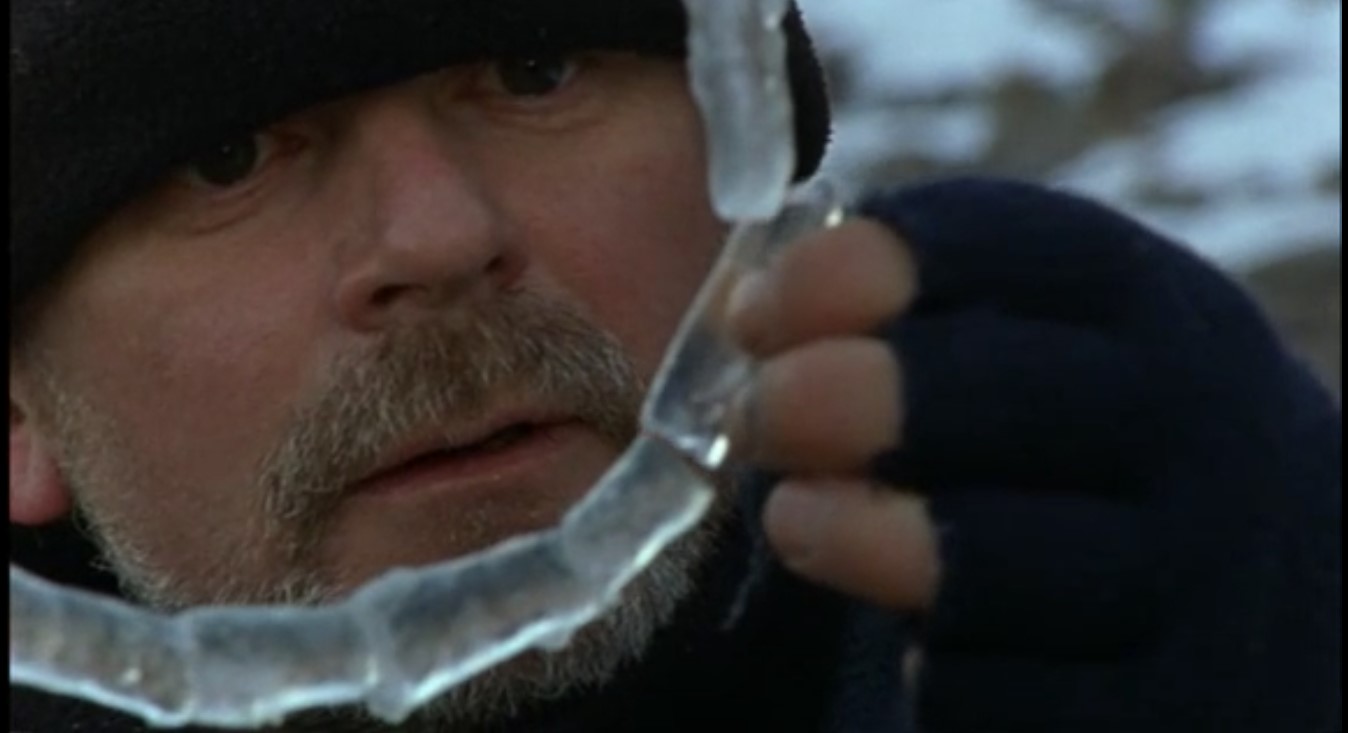
Ice structure.


This frame has cleverly captured the natural design of stones. It is also a similar to the design Andy Goldsworthy often draws in the documentary. This ups and downs and highs and the lows are also engraved in in human nature also. This frame has captured that rendition.


Goldsworthy prepares such art in various locations in nature and observes the natural process, whether it is destroyed quickly or not.


Each stone is kept very carefully because it's setup is necessary while creating any art.


Here, even after the tide is gone, Goldsworthy's art sustains. 


A small area that is nurturing youth and blossoming with the blend of nature. Just like nature, these player also cultivating sportsman spirit. A temperament of moving on in life.


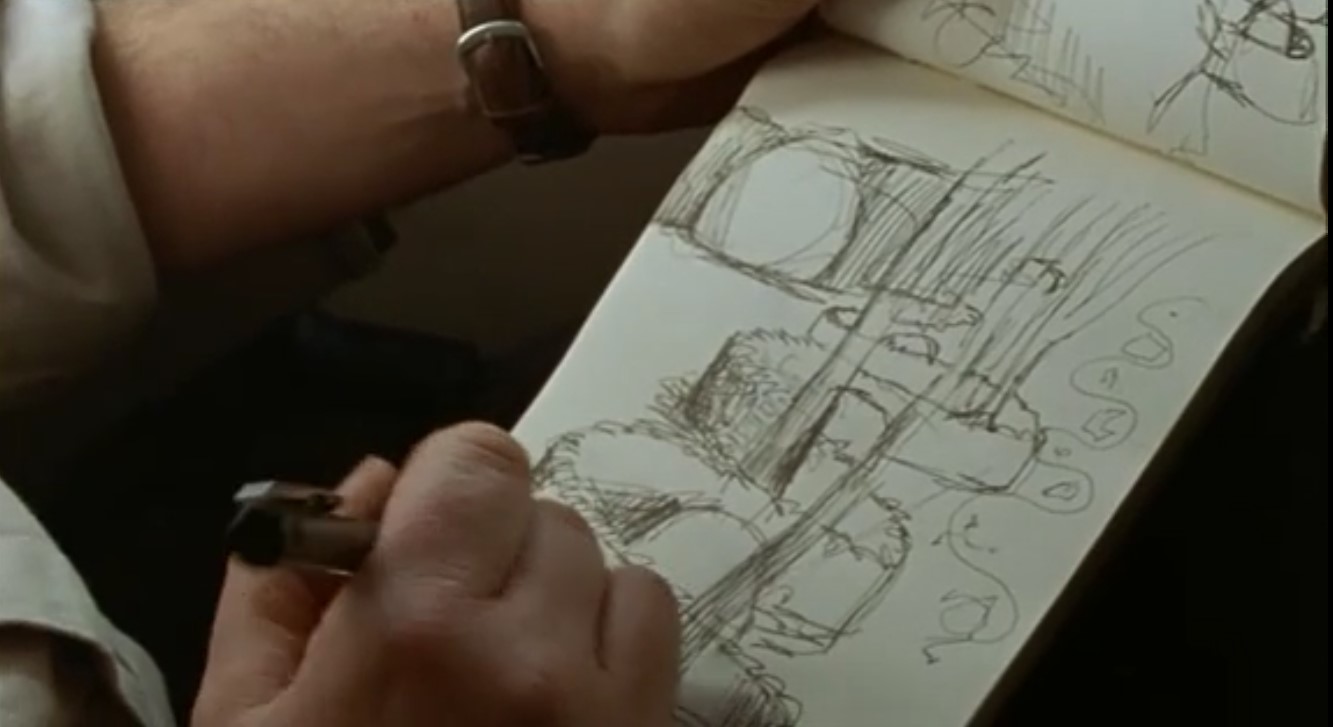
He also captures raw sketches in his diary.


This frame is captured from helicopter and it seems that this design has inspired Andy Goldsworthy to create the similar ones in different parts of nature.


This is the only frame where we find a contrast to the art he is creating in nature and the archived pieces of arts are preserved at his house. Also a blend of technology as we can see a desktop at the table. In short, art which he creates in nature is vanished very soon, within few seconds and minutes but here in his house he has preserved all the arts he has made.


Here, Andy Goldsworthy is trying to stop his art being vanished by his hand but nature has to be itself. He has created this 'web' with small wooden sticks and joined them through thorns.


His frustration is reflected in this frame. This is how humans are tend to preserve somethings and if it doesn't happen we all get frustrated and anxious. But it doesn't matter how much we are frustrated but how quickly we become free from that and overcome our anxiety is important.


This is the woolen art. Strings are spread all across the stone edges and its shining in the sunlight. It is also evident that wool is also something what we directly get from nature. Sheep is the animal who is quite rigid in nature and always follows the herd. But the wool we get from it, is quite opposite in nature. Wool is a symbol of tenderness and softness, which signifies positivity and kindness. But sheep is narrated very differently in various fields such as politics.


Even if someone travels in nature and wants to create something. No other instruments or other objects are required. Human body itself words as an instrument while working with nature.


Here are the seasonal changes recorded in the design made up from wooden sticks.


This frame is a kind of paradoxical in nature. Andy Goldsworthy here puts yellow flowers in a steady spot of water just nearby the fast flowing stream.


This wall of stones is a kind of dialogue to the trees.

This documentary is beyond the words. It takes us to a spiritual journey and transforms all our understanding of nature. One can surely say a true artist is always ready to witness the art's decay. It is possible only if one is spiritually mature.

Thank You!